
Quick Summary
- We treated a 50-year-old man who arrived with a proximal tibia fracture while under the influence of alcohol.
- Doctors may perform emergency or life-saving surgery even when a patient has consumed alcohol.
- We avoid elective surgery when a patient is drunk.
- We assess the patient’s condition, the urgency of surgery and the possible anaesthesia-related complications before making a decision.
- In this case, we considered the risk of compartment syndrome.
- We also discussed MIPO (Minimally Invasive Plate Osteosynthesis) as a surgical approach for the fracture.
- Our main message is simple: Do not drink alcohol.
Can You Drink Alcohol Before Surgery?
Can doctors perform surgery when a patient is drunk?
This question becomes important when someone suffers a fracture and needs immediate medical attention.
We recently saw a 50-year-old man who came to us with a proximal tibia fracture. He was completely drunk when he arrived.
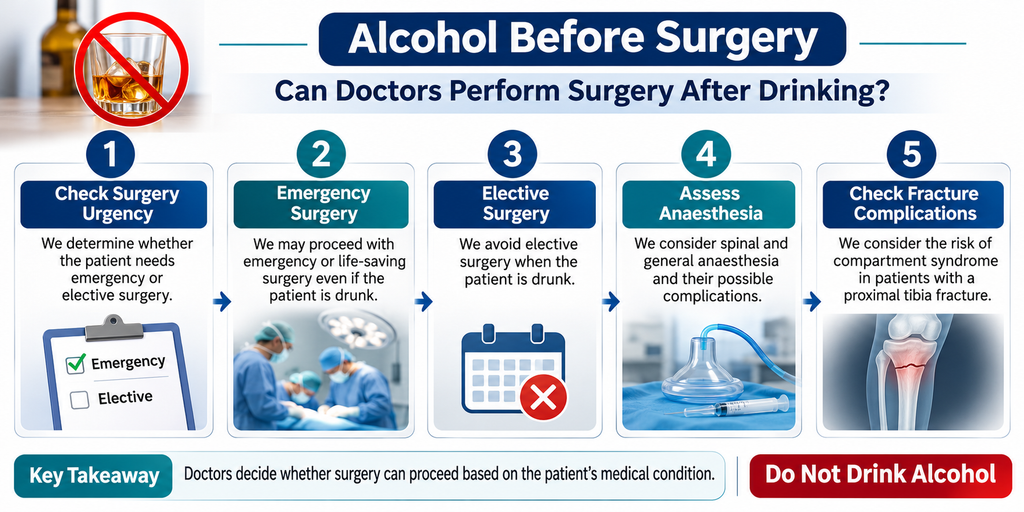
In situations like this, we first assess the patient’s condition and determine whether the surgery is an emergency or an elective procedure.
If the patient needs emergency surgery, we may need to proceed despite alcohol consumption. However, if the patient needs elective surgery, we avoid operating while the patient is drunk.
The patient’s condition and the urgency of treatment guide our decision.
Can Doctors Perform Emergency Surgery After Drinking Alcohol?
Yes. Doctors may perform emergency surgery even when a patient has consumed alcohol.
If someone needs life-saving surgery, we consider the urgency of the situation before deciding how to proceed.
However, we do not follow the same approach for every patient.
We assess the injury, the patient’s condition and the possible complications. We then decide whether the patient needs immediate surgery or whether the procedure can wait.
Alcohol consumption plays an important role in our assessment, but we also consider the patient’s overall medical condition.
Why Do We Avoid Elective Surgery After Drinking Alcohol?
We take a different approach when a patient needs elective surgery.
If the patient is drunk and the surgery is elective, we do not proceed at that time.
We first assess the patient’s condition and determine whether the operation can wait.
The main difference lies in the urgency of treatment.
Emergency surgery may require immediate attention, while elective surgery allows us to consider postponing the procedure.
We make the final decision after assessing the patient’s medical condition.
Alcohol and Anaesthesia: What Do We Consider Before Surgery?
When a patient has consumed alcohol, we consider the type of anaesthesia and possible complications before deciding how to proceed.
| Anaesthesia Type | What Do We Consider? |
| Spinal Anaesthesia | We may consider spinal anaesthesia in certain situations. We assess the patient’s condition before deciding whether this approach is appropriate. |
| General Anaesthesia (GA) | We consider the possible complications when a patient is drunk. We assess these risks before choosing general anaesthesia. |
| Final Decision | We evaluate the patient’s condition, alcohol consumption and the urgency of surgery before choosing the appropriate anaesthesia approach. |
We do not choose anaesthesia based on alcohol consumption alone. We consider the patient’s overall condition and the urgency of surgery before making the final decision.
What Happened to the Patient With a Proximal Tibia Fracture?
We recently saw a 50-year-old man who came to us with a proximal tibia fracture.
He was completely drunk when he arrived.
While assessing his injury, we considered the possibility of compartment syndrome, a complication that can occur after a leg fracture.
This concern made the timing of treatment an important part of our assessment.
We had to consider the urgency of surgery along with the patient’s condition and alcohol consumption.
Why Can Tibia Fracture Surgery Become an Emergency?
A proximal tibia fracture can sometimes lead to complications, including compartment syndrome.
In this patient’s case, we considered that possibility while assessing his injury.
We had to determine whether the fracture required emergency surgery or whether we could wait.
The possibility of compartment syndrome influenced our assessment of the urgency.
We considered this risk along with the patient’s condition before deciding how to proceed.
What Is Compartment Syndrome in a Leg Fracture?
Compartment syndrome is a complication that can occur after a leg injury or fracture.
When we assess a patient with a proximal tibia fracture, we consider the possibility of this complication.
We pay attention to the patient’s condition and any concerns about swelling.
The possibility of compartment syndrome can influence how urgently we need to manage the injury.
We assess the risk before deciding on the next step in treatment.
How Do We Use MIPO Surgery for a Tibia Fracture?
In this case, we discussed MIPO (Minimally Invasive Plate Osteosynthesis) as a surgical approach for treating the patient’s proximal tibia fracture.
We considered this option while assessing the fracture and the possible complications.
However, we do not decide on surgery based on the fracture alone.
We also consider the patient’s condition, the urgency of treatment and the possible anaesthesia-related complications.
The treating doctors decide whether and when to proceed with surgery.
What Should You Remember About Alcohol Before Surgery?
Alcohol consumption can affect how we approach a surgical procedure.
When a patient needs emergency or life-saving surgery, we may proceed even if the patient has consumed alcohol.
However, when a patient needs elective surgery, we avoid operating while the patient is drunk.
We also assess the patient’s condition, consider the possible complications and choose an appropriate anaesthesia approach.
Our main message is simple: Do not drink alcohol.
Frequently Asked Questions About Alcohol Before Surgery
1. Can you have surgery after drinking alcohol?
Yes. Doctors may perform emergency or life-saving surgery even after a patient has consumed alcohol. We assess the patient’s condition and the urgency of surgery before deciding how to proceed.
2. Can doctors perform elective surgery if a patient is drunk?
We avoid elective surgery when a patient is drunk. We assess the medical situation and decide whether the procedure can wait.
3. What are the general anaesthesia risks after drinking alcohol?
We consider the possibility of additional complications when a patient has consumed alcohol. We assess the patient’s condition before choosing between general anaesthesia and other appropriate approaches.
4. Why might a proximal tibia fracture require emergency surgery?
A proximal tibia fracture can lead to complications such as compartment syndrome. We consider this possibility when assessing the urgency of surgery.
5. What is compartment syndrome in a leg fracture?
Compartment syndrome is a complication that can occur after a leg injury or fracture. We consider this risk when assessing the patient’s condition and deciding how urgently to manage the injury.
6. What is MIPO surgery for a tibia fracture?
MIPO stands for Minimally Invasive Plate Osteosynthesis. We discussed this surgical approach while assessing the patient’s proximal tibia fracture and considering the treatment options.
Orthopaedic Emergency Care at Muthu Hospital Madurai
At Muthu Hospital, Madurai, we assess the patient’s condition, the type of fracture and the possible complications before deciding on treatment.
When a patient arrives after consuming alcohol, we also consider how alcohol consumption may affect the surgical and anaesthesia decisions.
We determine whether the patient needs emergency surgery or whether the procedure can wait.
Our main message remains the same: Avoid alcohol consumption and allow the treating doctors to assess the need for surgery.
About the Author
Dr. M. Mithran
Orthopaedic Surgeon
MBBS., D Ortho, DNB Ortho, MCH Ortho
Medical Registration Number: 79419
Dr. M. Mithran is an Orthopaedic Surgeon at Muthu Hospital, Madurai.
Muthu Hospital has provided orthopaedic care since 1953.
Leave a Reply