
Quick Summary
- A 22-year-old boy suffered a serious fracture after a high-speed bike accident.
- He initially underwent treatment with an external fixator at another hospital.
- When he later came to us, there were early signs that an infection was developing.
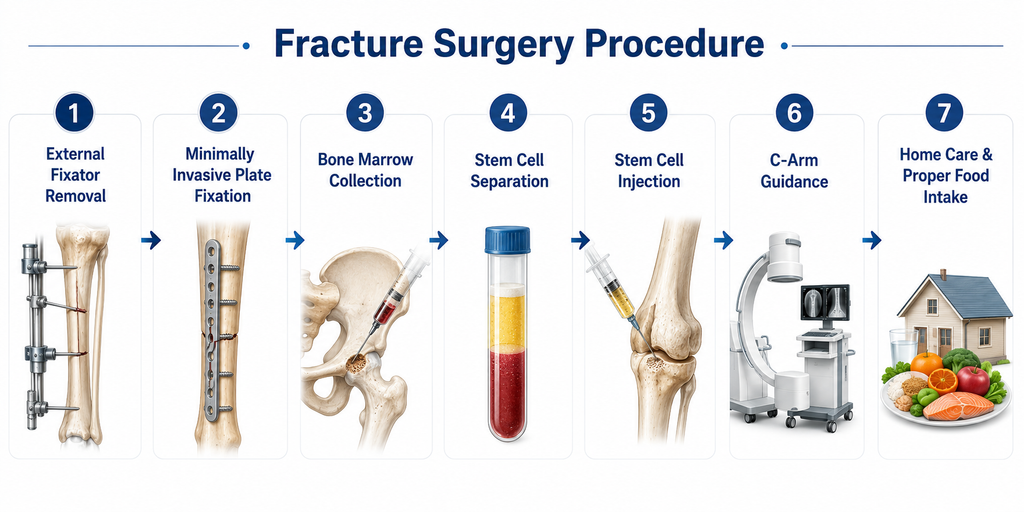
- We started antibiotics, removed the external fixator and performed plate fixation using a minimally invasive technique.
- As the bone had not healed properly, we collected bone marrow from the iliac region and separated stem cells for injection at the fracture site.
- We injected the stem cells at the fracture site under C-arm guidance.
- We advised the patient to maintain proper food intake and follow good home care to support complete bone fusion.
What Happened to the Patient After the High-Speed Bike Accident?
Today, I want to share the treatment journey of a 22-year-old boy who met with an accident while riding his bike at high speed.
Considering the velocity of the accident, the injury was quite concerning. He was initially taken to a nearby hospital, where the doctors performed first-aid surgery using an external fixator (ExFix).
The initial surgery was performed well. However, the patient had been looking for further treatment at several places because the fracture had not healed properly.
When he finally came to us, we noticed that an infection appeared to be starting, although it had not developed into a full-fledged infection.
Why Was Fracture Surgery Needed After External Fixation?
The main concern was that the patient should not remain with the external fixator for an extended period, as this could lead to infection.
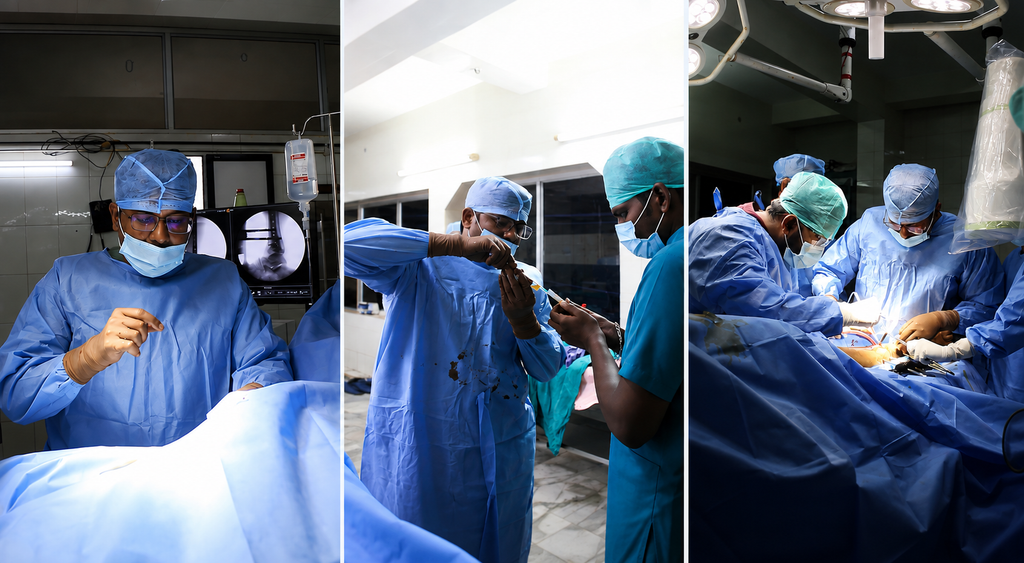
We therefore started him on antibiotics and decided to remove the ExFix.
After removing the external fixator, our plan was to perform internal fixation using a plate through a minimally invasive technique.
This allowed us to move from the initial external fixation to the planned internal fixation for this patient’s fracture.
How Does Plate Fixation Help Treat This Fracture?
After removing the external fixator, we performed internal fixation with a plate using a minimally invasive technique.
Instead of performing open surgery, the procedure was carried out through a small incision.
However, there was another important concern. The bone had not healed properly yet. Therefore, we needed to address the healing of the fracture as part of the same treatment plan.
How Did We Use Stem Cells to Support Bone Healing?
Since the bone had not healed properly, we collected bone marrow from the patient’s iliac region.
We then separated the stem cells from the collected bone marrow and prepared them for injection at the fracture site.
Next, we injected the stem cells directly at the fracture site under C-arm guidance.
We also collected the bone marrow through a small incision, allowing us to use a minimally invasive approach for the procedure.
How Did We Perform the Fracture Treatment Under C-Arm Guidance?
Once we prepared the stem cells, we injected them at the fracture site under C-arm guidance.
We performed the treatment using a minimally invasive approach rather than open surgery.
We executed the treatment plan as intended. I had high confidence that the bone would heal properly. At the same time, I explained that proper food intake and home care are essential for the bone to fuse completely.
Fracture Surgery Procedure Explained by Dr. Mithran
| Treatment Stage | What Was Done |
| Initial treatment | An external fixator was used after the high-speed bike accident. |
| Infection management | Antibiotics were started when early signs of infection appeared. |
| ExFix removal | The external fixator was removed. |
| Plate fixation | Internal fixation with a plate was performed using a minimally invasive technique. |
| Bone marrow collection | Bone marrow was collected from the iliac region through a small incision. |
| Stem cell preparation | Stem cells were separated from the collected bone marrow. |
| Stem cell injection | The stem cells were injected at the fracture site. |
| C-arm guidance | The injection was performed under C-arm guidance. |
| Aftercare | Proper food intake and home care were advised to support bone fusion. |
What Home Care Is Important After Fracture Surgery?
Completing the fracture surgery is only one part of the patient’s treatment journey.
In this case, I specifically emphasised that proper food intake and home care are essential for the bone to fuse completely.
Although I had high confidence that the bone would heal properly, following the advised home care remains important for the healing process.
Why Choose Muthu Hospital Madurai for Fracture Treatment?
I am an Orthopaedic Surgeon at Muthu Hospital Madurai, where we provide care for patients with trauma and fractures.
In this patient’s case, we had to consider his previous external fixation, the early signs of infection and the fact that the bone had not healed properly. Based on these factors, we planned antibiotics, ExFix removal, minimally invasive plate fixation and stem-cell injection at the fracture site.
Muthu Hospital has been serving Madurai since 1953, providing orthopaedic care including trauma, fracture, knee and hip replacement, and spine care.
Frequently Asked Questions About Fracture Surgery
What is fracture surgery?
Fracture surgery is surgical treatment for a broken bone. In this patient’s case, it involved removing the external fixator and performing internal fixation with a plate through a minimally invasive technique.
What is plate fixation?
Plate fixation is an internal fixation technique. In this patient’s case, we removed the external fixator and then used a plate for internal fixation.
Why Did We Remove the External Fixator?
The patient had been using an external fixator for an extended period, and there were early signs that an infection was developing. We therefore started antibiotics and decided to remove the ExFix.
What is bone break surgery?
Bone break surgery is a general term for surgical treatment of a broken bone. The treatment required for each patient depends on the fracture and the individual situation.
Why Did We Use Stem Cells in This Patient’s Treatment?
The patient’s bone had not healed properly. We therefore collected bone marrow from the iliac region, separated the stem cells and injected them at the fracture site under C-arm guidance.
Is home care important after fracture surgery?
Yes. In this patient’s case, I specifically explained that proper food intake and home care are essential for the bone to fuse completely.
Consult Dr. M. Mithran for Fracture Surgery
If you have a fracture after an accident and want to understand your treatment options, consult Dr. M. Mithran at Muthu Hospital Madurai.
I can assess your fracture, understand any previous treatment and discuss the appropriate treatment approach based on your individual condition. In the case discussed above, the treatment involved external fixator removal, minimally invasive plate fixation and stem-cell injection at the fracture site.
Consult Dr. M. Mithran to understand the right treatment approach for your fracture.
👉 Schedule an Appointment Today
About the Author
Dr. M. Mithran
Orthopaedic & Joint Replacement Surgeon
Dr. M. Mithran is an Orthopaedic & Joint Replacement Surgeon at Muthu Hospital Madurai. He specialises in knee, hip and total joint replacement, along with orthopaedic trauma and fracture care.
With over 2,500 successful joint replacements, Dr. Mithran received the Best Orthopaedic & Joint Replacement Surgeon of South India – 2025 award. He also performs bilateral joint replacement surgeries, making him the only surgeon in the region to offer this procedure.
Muthu Hospital has served Madurai since 1953, providing orthopaedic care including trauma, fracture, knee and hip replacement, and spine care.
Leave a Reply