
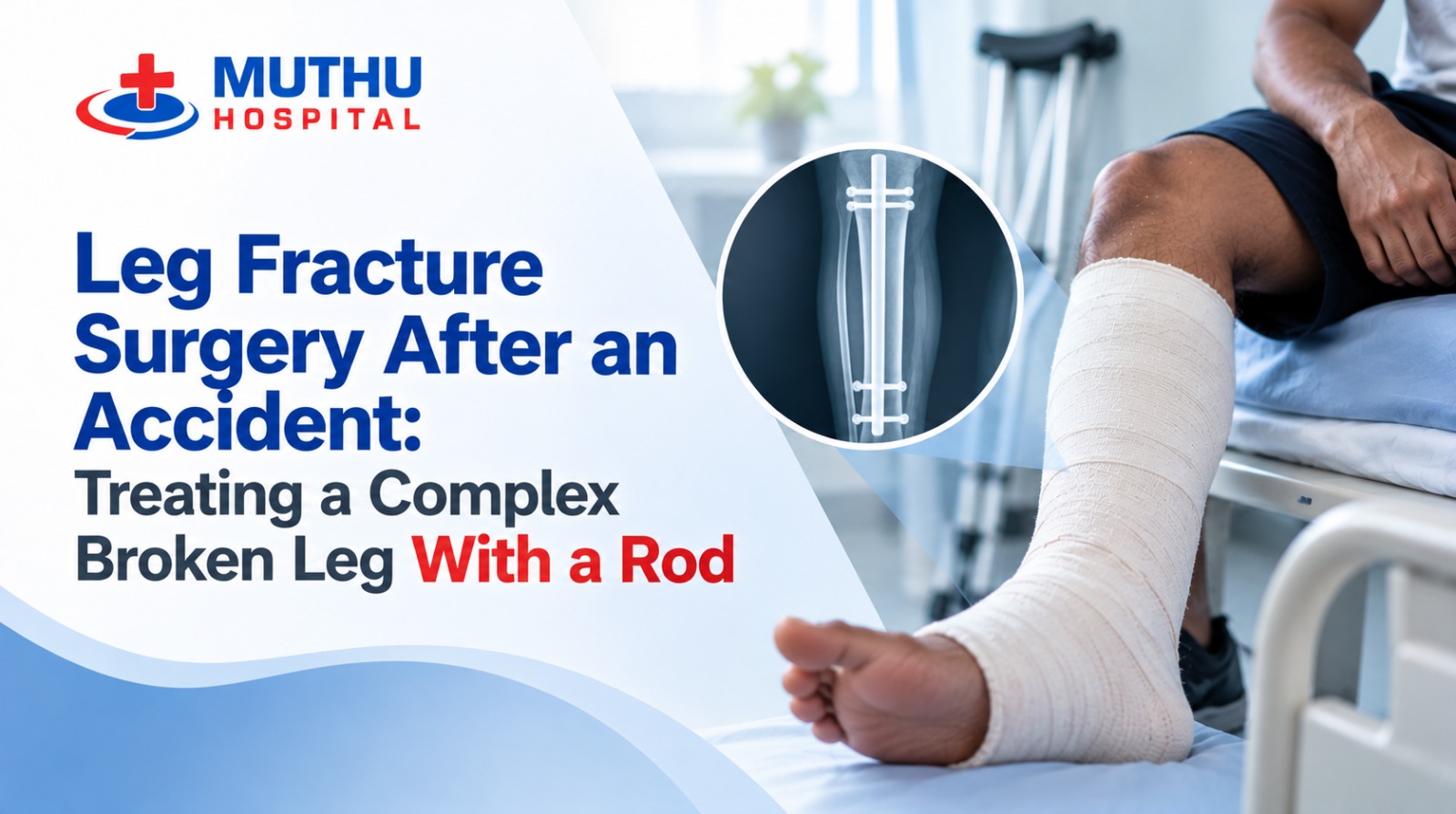
Quick Summary
- A 60-year-old man from Thirupuvanam, near Mannikottai village, came to Muthu Hospital after a high-speed car accident.
- The accident caused the bone below his knee to break into four pieces, while the calf bone broke into three pieces.
- Doctors initially treated him with an external fixator.
- When he came to us, he also had an open wound infection and a haemoglobin level of 5.
- We cleaned the wound and transfused three units of blood before planning permanent fixation.
- I considered both plate fixation and an interlocking rod before choosing the fixation method.
- We used jigs through a small keyhole to guide the rod and secured it with two locking screws.
What Happened to the Patient After the Accident?
The patient, a 60-year-old man from Thirupuvanam near Mannikottai village, met with a high-speed car accident.
Doctors at a local hospital initially treated him with an external fixator. After that initial treatment, his family brought him to Muthu Hospital to consult me.
When I examined his X-ray, I found multiple fractures in the bone below his knee. The bone had broken into four main pieces, along with several smaller fracture fragments. The calf bone had also broken into three pieces.
I described this pattern as a segmental fracture.
Why Did He Need Leg Fracture Surgery?
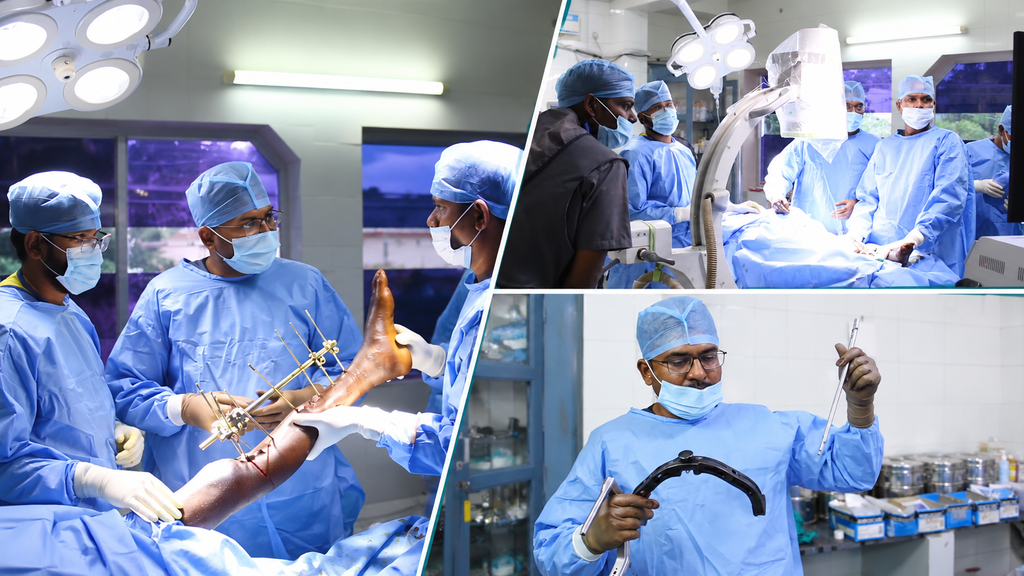
The previous doctors had treated the fracture with an external fixator. However, the patient also had an open wound infection when he came to us.
Before we moved ahead with permanent fixation, we first cleaned and treated the wound.
Two days earlier, we took him to the operation theatre and thoroughly washed and cleaned the wound. His haemoglobin level was only 5, so we transfused three units of blood to improve his condition.
After addressing these concerns, we planned the definitive fixation.
What Did the X-Ray Show About the Broken Leg?
The X-ray showed that the bone below the knee had broken into four pieces. The calf bone had also broken into three pieces.
Along with these main fragments, the patient had several smaller fracture pieces.
I explained this as a segmental fracture, which made the fixation more challenging.
Which Fixation Options Did We Consider?
For the permanent fixation, I considered two options.
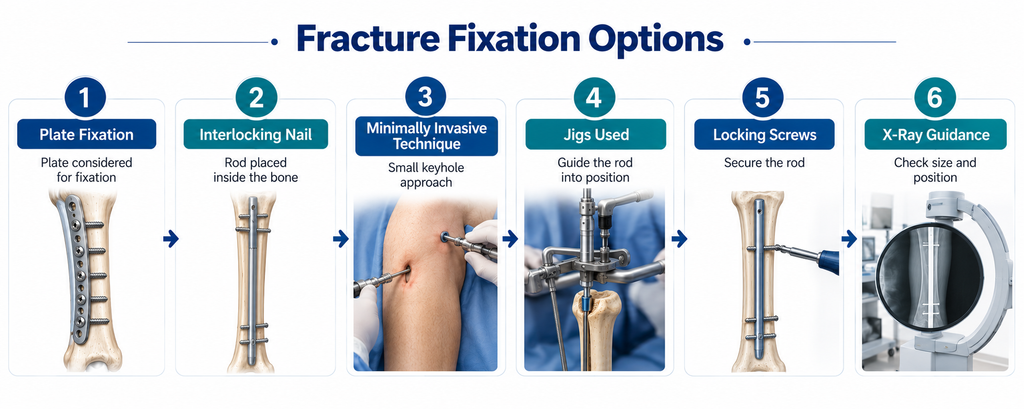
The first option involved using a plate. The second involved using an interlocking nail, which is a rod placed inside the bone.
I decided on the fixation approach based on what I could achieve for this particular patient.
For this procedure, we chose the rod-based fixation approach.
How Does an Interlocking Nail Help Fix the Broken Bone?
An interlocking nail is a rod that goes inside the bone. In this patient’s case, we used jigs to guide the rod accurately through a small keyhole.
Instead of opening the entire area to insert the rod, we used the jigs to guide and position it precisely.
We then secured the rod with two locking screws.
This allowed us to perform the fixation using a minimally invasive technique.
Why Did We Use a Minimally Invasive Technique?
The jigs helped us perform the procedure through a small keyhole.
I explained that we did not need to open the entire bone to insert the rod. We used the jigs to guide the rod and position it accurately inside the bone.
After positioning the rod, we secured it with two locking screws.
The surgical footage shows the team performing the procedure with C-arm X-ray guidance.
How Did We Select the Right Rod for the Patient?
Every person’s anatomy has a different size. Because of this, I don’t use one standard rod for every patient.
We keep around 30 different rods in stock. I select the appropriate rod size according to the patient’s anatomy.
We then verify the size and position using the X-ray machine before inserting the specific rod.
This allows us to select the rod according to the individual patient’s anatomy.
What Happens During Broken Leg Rod Surgery?
In this patient’s case, we guided the rod inside the bone through a small keyhole using jigs.
Once we positioned the rod correctly, we secured it with two locking screws.
We also used the X-ray machine to check the position during the procedure.
This approach formed the main part of the patient’s broken leg rod surgery.
What Should Patients Know About Broken Tibia Surgery?
People searching for broken tibia surgery may want to understand how doctors fix a complex fracture using a rod.
In this patient’s case, the doctor described fractures in the bone below the knee and the calf bone. I considered plate fixation and rod fixation before selecting the approach for him.
The procedure used jigs, a small keyhole and locking screws to position and secure the rod.
Fracture Fixation Options Discussed for This Patient
| Fixation Option | What We Considered |
| Plate fixation | I considered a plate as one option for permanent fixation. |
| Interlocking nail | I also considered a rod placed inside the bone. |
| Final fixation | We selected the approach based on what we could achieve for the patient. |
| Jigs | We used jigs to guide the rod through a small keyhole. |
| Locking screws | We secured the rod with two locking screws. |
| X-ray guidance | We used the X-ray machine to verify the rod size and position. |
How Long Does Bone Healing Take After the Fixation?
I explained to the patient that natural bone healing takes around 2 to 3 months.
In this case, the fixation made the bone 3 to 4 times stronger than before, according to my explanation, and it could allow the patient to walk as early as the following day.
The patient’s activity and recovery plan depend on his individual condition and surgical assessment.
Why Choose Muthu Hospital Madurai for Fracture Treatment?
At Muthu Hospital Madurai, we provide orthopaedic care including trauma and fracture treatment.
I am Dr. M. Mithran, an Orthopaedic & Joint Replacement Surgeon at Muthu Hospital. I specialise in knee, hip and total joint replacement, along with orthopaedic trauma and fracture care.
Muthu Hospital has served Madurai since 1953, providing orthopaedic care including trauma, fracture, knee and hip replacement, and spine care.
If you have suffered a fracture or received an external fixator after an accident, a consultation can help us assess your condition and discuss the appropriate fixation approach.
Frequently Asked Questions About Leg Fracture Surgery
What is leg fracture surgery?
Leg fracture surgery involves surgical fixation of a broken bone. In this patient’s case, we used a rod for permanent fixation after his initial treatment with an external fixator.
What is an interlocking nail?
An interlocking nail is a rod that goes inside the bone and receives support from locking screws. In this case, we used jigs to guide the rod through a small keyhole.
Why did the patient need further surgery after external fixation?
The patient came to us with an open wound infection, and his haemoglobin level was only 5. We first cleaned the wound and transfused three units of blood before planning definitive fixation.
What is a segmental fracture?
A segmental fracture describes the fracture pattern Dr. Mithran identified in this patient, where the bone below the knee had broken into multiple pieces.
Why did you use a rod instead of a plate?
I considered both a plate and an interlocking rod. I selected the fixation method based on what I could achieve for this particular patient.
How did you choose the correct rod?
We keep around 30 different rods in stock. I select the appropriate size according to the patient’s anatomy and verify it using the X-ray machine before inserting it.
How long does bone healing take?
In this case, I explained that natural bone healing takes around 2 to 3 months.
Consult Dr. M. Mithran for Leg Fracture Treatment in Madurai
If you have suffered a serious leg fracture after an accident or received an external fixator as initial treatment, consult Dr. M. Mithran at Muthu Hospital Madurai.
During consultation, I can assess the fracture and discuss the fixation options based on the patient’s anatomy and condition.
Book a consultation to discuss your fracture treatment options.
About the Author
Dr. M. Mithran
Orthopaedic & Joint Replacement Surgeon
Dr. M. Mithran is an Orthopaedic & Joint Replacement Surgeon at Muthu Hospital Madurai. He specialises in knee, hip and total joint replacement, along with orthopaedic trauma and fracture care.
Muthu Hospital has served Madurai since 1953, providing orthopaedic care including trauma, fracture, knee and hip replacement, and spine care.
Leave a Reply